
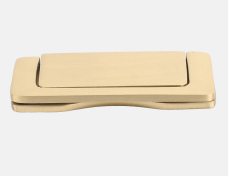
Not every furniture-hardware choice follows the long-bar or round-knob format. The catalogue includes more expressive forms that can become a focal detail on a cabinet front. Models 6626, 6648 and 8863 provide three useful examples in the selected collection.
Keep the catalogue labels intact
The 6626 brushed-brass entry is listed at 74 mm width, 6 mm printed height and 60 g. Model 6648 is listed at 82 mm width, 74 mm height and 60 g. The brushed-brass 8863 semicircle is listed with a 100 mm top diameter, 19 mm height and 175 g.
These are different profiles, and their table headings should not be forced into one assumed engineering convention. A printed height on a flat or shaped piece may need clarification for the particular mounting arrangement.
| Model / finish | Printed dimensions | Catalogue page |
|---|---|---|
| 6626Brushed brass · row 1 | width 74 mm · height 6 mm · weight 60 g | PDF 11 Printed 18 |
| 6648Brushed brass · row 1 | width 82 mm · height 74 mm · weight 60 g | PDF 13 Printed 22 |
| 8863Brushed brass · row 1 | top diameter 100 mm · height 19 mm · weight 175 g | PDF 14 Printed 23 |
A feature detail needs a clear location
Place the proposed shape on the cabinet drawing at the intended scale. Review its relationship with the front edges, joints and nearby hardware. If you plan to use two pieces together, explain that arrangement rather than assuming a product photograph establishes a paired fixing pattern.
The model name and image can communicate the visual idea. Request a drawing or sample for mounting geometry, clearances and any dimension that is not stated in the printed table.
8863 across the finish selection
The selected collection includes 8863 in brushed brass, brushed nickel and white. The white entry identifies a 100 mm top diameter, 19 mm height and 175 g weight. The brushed-nickel table uses a width label for its 100 mm dimension.
Keep the source wording with the chosen finish and ask for a drawing when reconciling the dimension labels matters to the design. It is better to leave that point explicit than to silently rename one measurement and imply a technical confirmation that has not been made.
Describe the design intent alongside the part
A useful enquiry includes the model and finish, the intended position, quantity and any drawing reference. For a variation, identify which part of the catalogue reference is the starting point and what you would like changed.
These steps make an expressive shape a manageable specification. They also separate a design direction from the practical confirmation and commercial quotation that need to follow.