
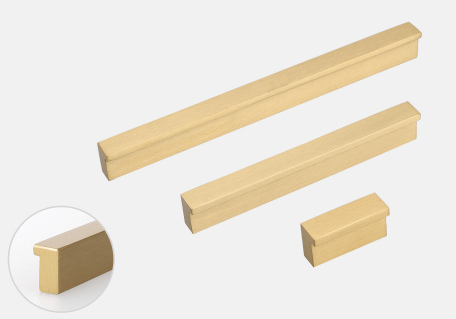
The LONGLIN company catalogue states that the factory can process and customise from customer drawings and samples. A good enquiry connects the design idea to the information needed for a practical review. It does not need to begin with a finished manufacturing pack, but it should make the known details and open questions easy to distinguish.
Identify the starting point
If the idea begins with a catalogue reference, note that model and finish first. For example, the angular 8815 pull family, the rounded 8825 family and the 6662 knob offer different starting forms. Explain which features you would keep and which you would like to change.
For a new shape, provide a drawing reference or sample description. Give a revision or date to drawings so later changes can be discussed without mixing earlier and current versions.
Make the dimensions work as a set
Record overall dimensions, fixing positions and the furniture interface. Where a requirement is not yet decided, label it as a point for review rather than adding a guessed dimension to complete the form.
The catalogue shows why complete rows matter. The 8815 brushed-brass table includes a 128 mm-centre row at 160 mm overall length, 11 mm width and 17 mm printed height. A reference that says only “128 mm handle” would leave the actual starting geometry unclear.
| Model / finish | Printed dimensions | Catalogue page |
|---|---|---|
| 8815Brushed brass · row 1 | hole centres 16 mm · length 32 mm · width 11 mm · height 17 mm · weight 37 g | PDF 4 Printed 04 |
| 8815Brushed brass · row 2 | hole centres 32 mm · length 50 mm · width 11 mm · height 17 mm · weight 57 g | PDF 4 Printed 04 |
| 8825Coffee · row 1 | hole centres 64 mm · length 95 mm · width 19 mm · height 17 mm · weight 117 g | PDF 18 Printed 32 |
| 8825Coffee · row 2 | hole centres 96 mm · length 128 mm · width 19 mm · height 17 mm · weight 163 g | PDF 18 Printed 32 |
| 6662Antique brass · row 1 | top diameter 20 mm · height 32 mm · weight 75 g | PDF 20 Printed 35 |
| 6662Antique brass · row 2 | top diameter 14 mm · height 25 mm · weight 31 g | PDF 20 Printed 35 |
Put appearance and material requirements in words
Use a named catalogue finish or a sample reference as the starting appearance. State the material requirement where it is part of the brief. Selected catalogue tables identify brass 57-3, but a custom requirement should still be explicitly reviewed rather than carried across by assumption.
If a finish must coordinate with another component, describe that relationship and discuss the sample that would be used for comparison. A photograph alone does not establish an agreed colour, gloss or surface treatment.
Include the commercial questions without presuming the answers
Tell the team the intended quantities, destination and timing you would like reviewed. Ask for confirmation of sample arrangements, any tooling questions, pricing and the proposed production and delivery plan.
The website does not publish a universal minimum quantity, stock level or lead time. Sending a detailed enquiry begins the discussion; it does not establish those arrangements automatically.
Keep one approved reference as the discussion develops
When a drawing or sample changes, update the reference on the product schedule and the correspondence. Separate alternative sizes or finishes into their own lines. The goal is a brief that can be reviewed, quoted and checked without relying on a verbal description of “the same handle as before”.
Use the enquiry form to send your model shortlist and project information. Mention any drawings or physical samples you would like to discuss, and confirm how to share them with the team.