
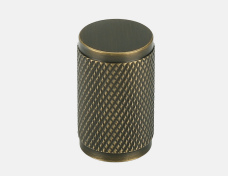
Coffee and antique brass both appear in the catalogue, but they are separate named finishes. Model 6662 is shown in both, providing a useful reference for comparing those names on a related knurled knob form. The catalogue also places coffee on the 6611 knob family and antique brass on model 6671.
Start with a shared model
The 6662 entries contain two size rows: a 20 mm top diameter with a printed height of 32 mm and weight of 75 g, and a 14 mm top diameter with a height of 25 mm and weight of 31 g. The same size figures appear in the selected coffee and antique-brass entries.
Keeping the size constant makes the finish discussion more precise. A comparison between a larger knob in one finish and a smaller knob in another mixes two separate decisions: the visible colour direction and the scale of the object.
| Model / finish | Printed dimensions | Catalogue page |
|---|---|---|
| 6662Coffee · row 1 | top diameter 20 mm · height 32 mm · weight 75 g | PDF 19 Printed 34 |
| 6662Coffee · row 2 | top diameter 14 mm · height 25 mm · weight 31 g | PDF 19 Printed 34 |
| 6662Antique brass · row 1 | top diameter 20 mm · height 32 mm · weight 75 g | PDF 20 Printed 35 |
| 6662Antique brass · row 2 | top diameter 14 mm · height 25 mm · weight 31 g | PDF 20 Printed 35 |
Then compare another silhouette
Model 6611 in coffee offers a wider size family, with seven listed rows. Model 6671 in antique brass is shown with a 28 mm width, 28 mm printed height and 79 g weight. These references introduce different forms and dimensions, so they should be considered as separate selections rather than substitutions based only on colour.
A finish-led shortlist can be useful, but the model number keeps the shape clear. The complete dimension row then identifies the version of that shape you want to discuss.
Give texture room in the brief
The product photographs help explain a textured or fluted outline. For a design decision involving touch, grip or the relationship with a furniture surface, request a sample and review it on the intended application.
The catalogue names and photographs do not establish a universal surface-treatment process or a maintenance regime. Ask for confirmation of any finish or care requirement that is important to the project.
Specify alternatives in separate lines
If the project is still comparing coffee and antique brass, label them as alternatives and keep the model and size beside each. This prevents an enquiry for a finish comparison from appearing to request an unspecified mixture.
When the choice is ready, carry the approved reference into the quotation and sample discussion. Current availability, pricing, quantities and production arrangements need direct confirmation; the comparison itself is a selection exercise, rather than a statement about stock.